
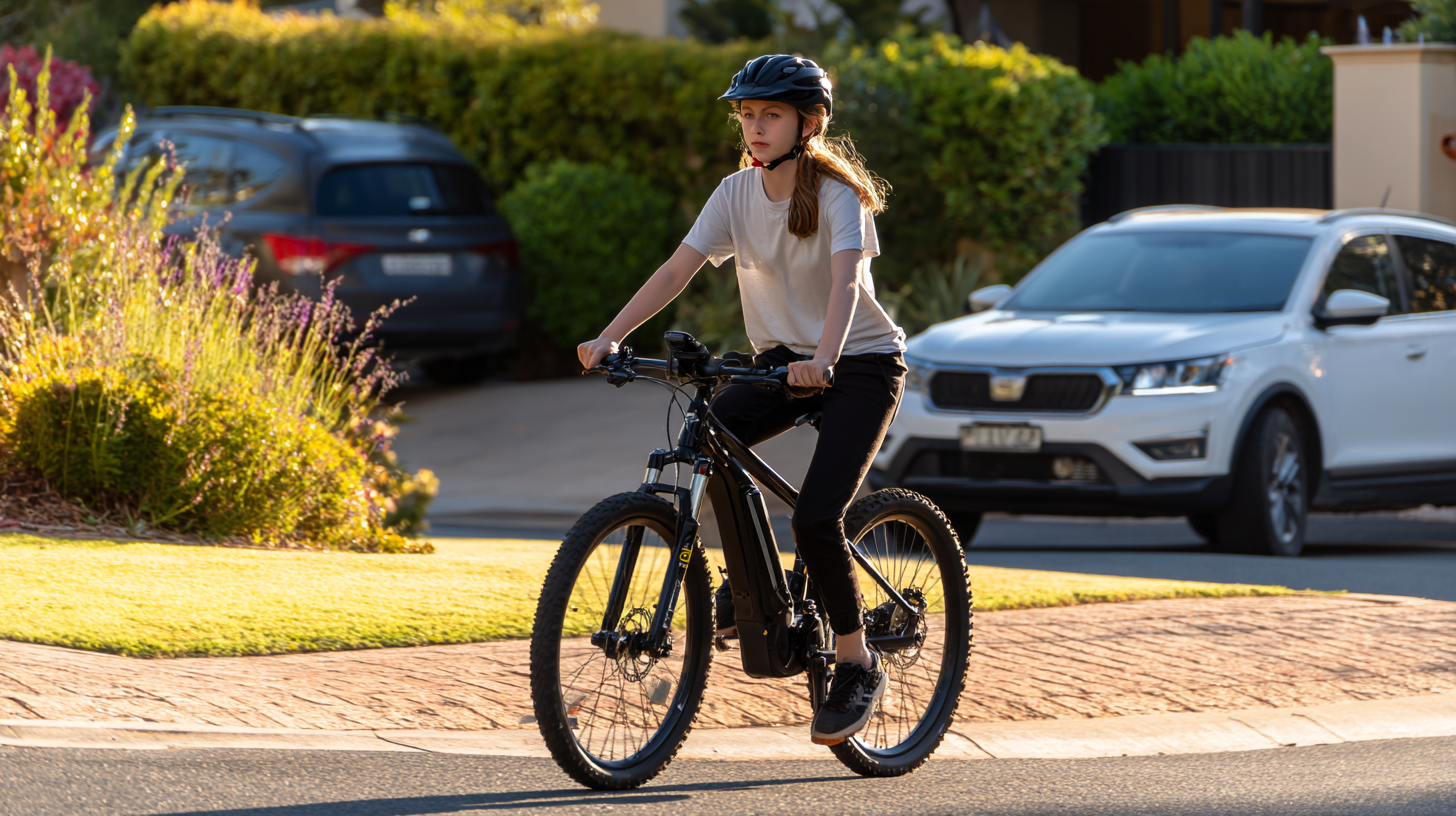
E-bikes are no longer a novelty on NSW roads, shared paths and around our schools. For many people, they offer a practical, affordable and enjoyable way to get around. They can help reduce short car trips, connect people to public transport, support independence and make active travel possible for people who may not otherwise choose to ride.
Youthsafe recognises these benefits. E-bikes can be part of a healthier, more sustainable and more connected transport future. But their rapid growth has also created a new and very real road safety challenge.
On streets, shared paths, around schools and in town centres, riders, pedestrians and drivers are now negotiating a more complex environment. A device that looks like a bicycle may behave quite differently if it is heavier, faster, modified or being ridden without enough understanding of the road rules. The issue is not simply the technology itself. It is how to optimise safety across a diverse range of travel modes and motivations in limited spaces.
That is why Youthsafe sees the current e-bike discussion as a major opportunity: not only to reduce dangerous and illegal riding but to lift the road sharing intelligence of every road user. Whether we drive, ride, walk, supervise young learners, teach in schools, work with young people or simply move through our local community, everyone uses roads and paths in some way.
A fast-changing safety issue
The growth in e-bikes and other forms of micromobility has happened quickly. NSW Government data has identified more than one million e-micromobility devices in NSW homes, with people using them for public transport connections, local trips and alternatives to car travel. At the same time, hospitals and trauma specialists have reported concerning increases in serious e-bike-related injuries.
This does not mean the answer is to reject e-bikes. It does mean the safety response needs to catch up with the speed and scale of change.
Some of the most concerning risks involve devices that are not really legal e-bikes at all. Many high-powered or throttle-only devices behave more like electric motorbikes than bicycles. Some have been modified to exceed legal speed or power limits. These devices can be dangerous for riders, pedestrians, drivers and passengers, particularly when used in crowded or unpredictable environments.
However, Youthsafe is also careful not to frame this as a problem caused only by young people. Illegal and high-risk use is not confined to teenagers. Poor road sharing, lack of rule knowledge, riding too fast for the conditions, footpath conflicts, distraction and impatience are behaviours found across age groups and across transport modes.
If we make the issue only about “young riders”, we miss the broader cultural challenge.
The road rules do matter
By law a legal e-bike is treated much like a conventional bicycle. That means riders need to know and follow the road rules.
Some of the key reminders are simple but important. Riders must wear an approved helmet that is securely fitted and fastened. A legal e-bike motor must stop providing power once the e-bike reaches 25 km/h. Adult riders are not legally permitted to ride on footpaths unless they fall within specific exemptions, such as supervising a child under 16. Riders must give way to pedestrians on shared paths and ride to the conditions. Bicycle riders also need to signal clearly when turning right or changing direction and obey the same general road rules as other road users.
These rules are not just technicalities. They are part of the social contract that allows different road users to share limited space safely.
Shared paths are a good example. They are often used by walkers, runners, children, older people, people with disability, dog walkers, bike riders and e-bike riders. The speed and vulnerability of these users can be very different. Clearer signage and repeated community reminders are needed so that all users understand the basics: keep left wherever practical, give way to pedestrians, slow down near others, use a bell or voice early and respectfully and expect the unexpected.
Constant awareness and small considerations can prevent serious injuries.
Road sharing should be built into driver education
Much of the current e-bike conversation focuses on riders. Rider education is essential, but it is only one part of the solution.
Drivers also need better preparation for sharing the road with bicycles, e-bikes, e-scooters, motorcycles and pedestrians. As micromobility grows, increased attention should be given to vulnerable road users throughout the learner licensing journey. Youthsafe believes this should include the Driver Knowledge Test, the Hazard Perception Test, the Safer Drivers Course and the qualifying Driving Test itself.
New drivers should be encouraged to think about vulnerable road users not as occasional hazards but as a normal and growing part of the traffic environment. They need to learn how to scan for riders, anticipate unpredictable movement, give safe passing distance, manage dooring risk, slow down around shared environments and understand how intimidating a vehicle can feel to someone outside it.
The same principle applies in reverse. Riders need to understand how drivers see, miss, misjudge or respond to them. Safer roads require mutual awareness, not competing entitlement or complacent expectations
Youthsafe’s role
Youthsafe has been actively engaged in this emerging area because it sits squarely within our mission to keep young lives free from serious injury.
Last year, Youthsafe developed an e-bike safety infographic for young people, parents, carers, teachers and youth workers. The resource brings together practical safety messages about legal bikes, helmets, visibility, riding behaviour, maintenance, charging and the risks associated with modified or inappropriate devices.
Youthsafe is also developing sessions for schools that will give students practical, age-appropriate safety guidance. These sessions will not simply tell young people what to do and what not to do. They will explore real-world decision-making: peer influence, road rules, shared path behaviour, safe responses to aggression or pressure and the importance of looking after friends.
In addition, Youthsafe has contributed to broader policy and stakeholder discussions, including participation in the NSW Government’s E-bike Roundtable and consultation processes for the 2031 Road Safety Action Plan. Youthsafe also recently presented at an e-bike and e-scooter stakeholder forum hosted by The George Institute for Global Health, where we emphasised that safer e-bike use requires mindful contribution from all road users, policy makers and the wider community.
Our message is consistent: education, regulation, enforcement, infrastructure and culture all need to work together.
New laws and the question of age limits
Recent NSW reforms have sharpened the focus on illegal and high-powered devices. The Road Transport Amendment (Non-registrable Motor Vehicles) Act 2026 gives NSW Police and Transport for NSW stronger powers to deal with illegal devices, including seizure and destruction in certain circumstances. The NSW Government has also reduced the legal e-bike power limit from 500 watts to 250 watts and mandated the European EN15194 technical standard for all e-bikes.
The Government has also indicated that a minimum age limit for e-bike use will be introduced.
Youthsafe understands why age limits are being considered, particularly given community concern about very young riders using powerful devices in complex traffic and shared path environments. A minimum-age approach may reduce the number of young riders on roads and paths in the short term, particularly among younger teenagers.
But there may also be unintended consequences. If young people are largely excluded from e-bike use until 16, many may reach that age with their attention already focused on getting a learner driver licence, buying a car or moving quickly into motor vehicle use. That would be a missed opportunity if it means they have had little meaningful exposure to road sharing, active travel, safe riding and shared responsibility before entering the driver licensing system.
This is why Youthsafe believes education remains essential, whatever final age settings are adopted. Young people need road safety learning before they become drivers, not only once they are preparing for a licence.
A shared responsibility
E-bikes have arrived quickly but the wider issue is familiar. Road safety has always depended on the choices people make around others: how much space we give, how quickly we travel, how well we look, how calmly we respond and how seriously we take our responsibility to people more vulnerable than ourselves.
The rise of e-bikes gives NSW an opportunity to improve more than one category of transport. It gives us the chance to improve our shared road culture.
Youthsafe will continue to advocate for practical education, clear rules, safer school and community environments, better road sharing in licensing and support for parents, carers and schools trying to guide young people through a changing transport world.
The goal is not to remove the freedom, convenience and enjoyment that e-bikes can offer. The goal is to make sure those benefits are not purchased at the cost of preventable serious injury.
Together, we can help young people — and all road users — share roads and paths with more awareness, more patience and more care.